

How To Draw Fancy Cursive Letters How To Draw Fancy Letters
Everyday and everywhere, you are surrounded by letters and written letters. From logotypes to posters, billboards, t-shirts or book covers, messages not but tell a story but evoke sure emotions also. What if, instead of using an already existing font, you could draw cute paw lettering that's total of personality?
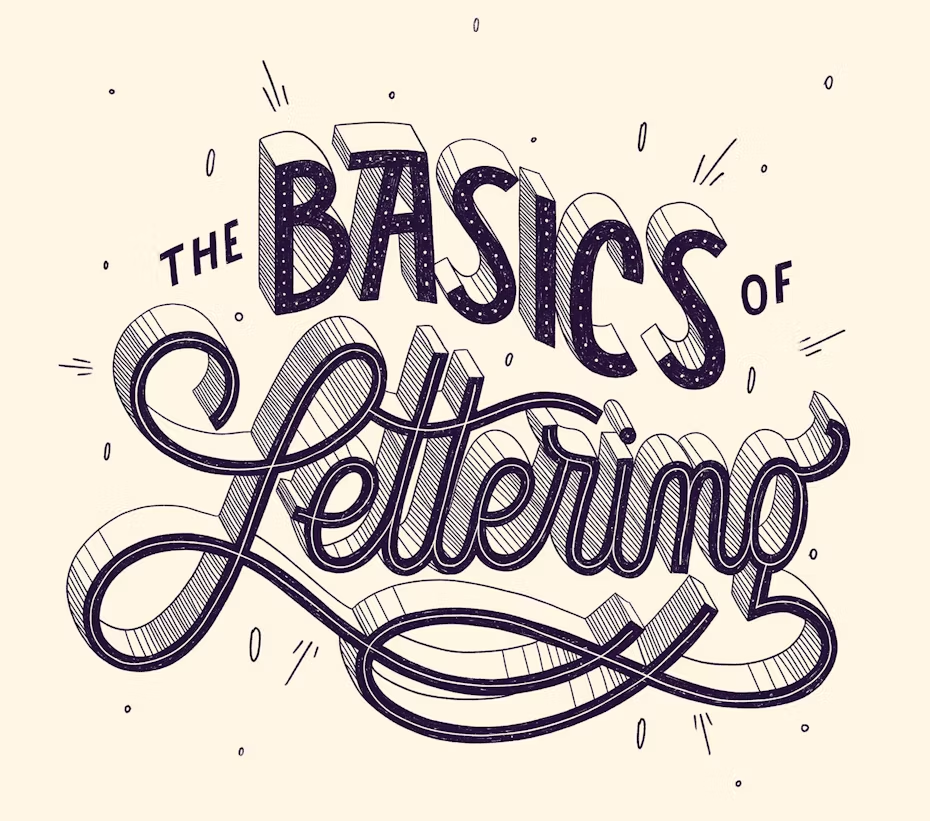
Even if you've already dipped your toes into the infinite universe of hand lettering, or you've thought near trying information technology out just weren't sure where to starting time, yous are in the correct place! Nosotros're going to have a look at the essentials that you demand to commencement this wonderful journey of hand lettering.
I've been hand lettering for a fiddling over a year, and information technology all started when a weekly claiming popped up on Instagram and I decided to enroll. I previously played around with calligraphy, but I wasn't really sure what the divergence betwixt that and hand lettering was. I had zilch experience, never taken a class, never watched someone do it live. I just thought it would be fun—and it was! Since then, I've been lettering about daily, and learning this skill has been one of the all-time things I've ever washed!
By the finish of this commodity, y'all'll know the basics of paw lettering and take the conviction to create your own pieces!
What is hand lettering?
—
Many people out there confuse manus lettering, calligraphy, typesetting and type design and use the term "type" or "typography" to refer to all of these.
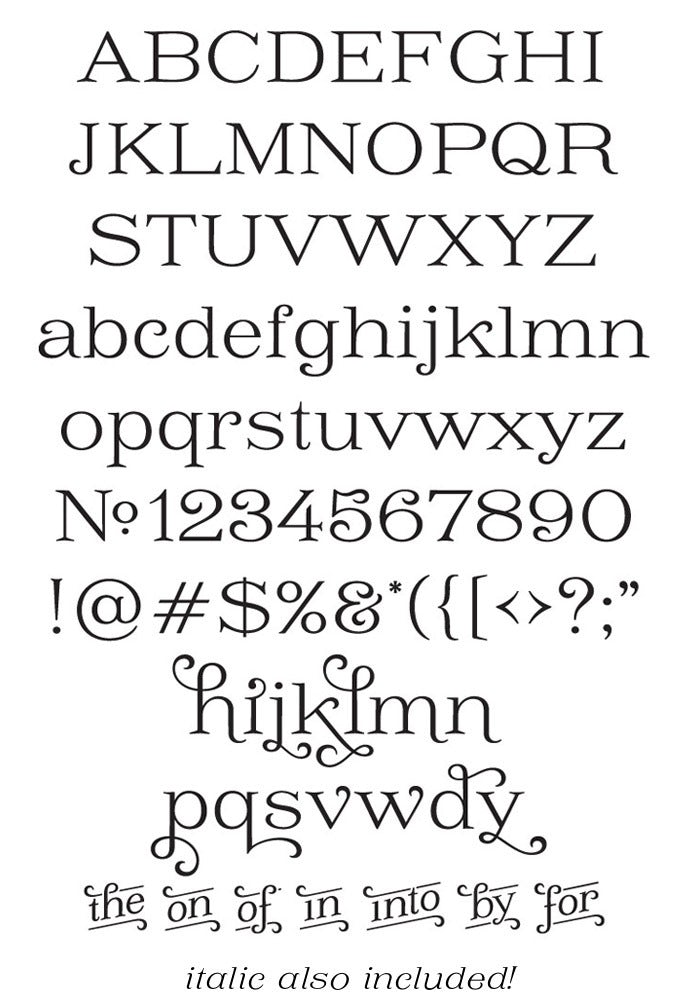
Blazon blueprint
Blazon design is the process of making typefaces which all of us can apply. A type designer creates systems of letters, making certain that all messages of the alphabet work together in endless combinations.
Typesetting only means arranging blazon that's been created past a type designer in a given layout. This might be every bit simple as a black and white newspaper or every bit circuitous every bit a typography-driven brochure.
Back in the twenty-four hour period, this was done by hand. Today, we exercise information technology all on a computer.
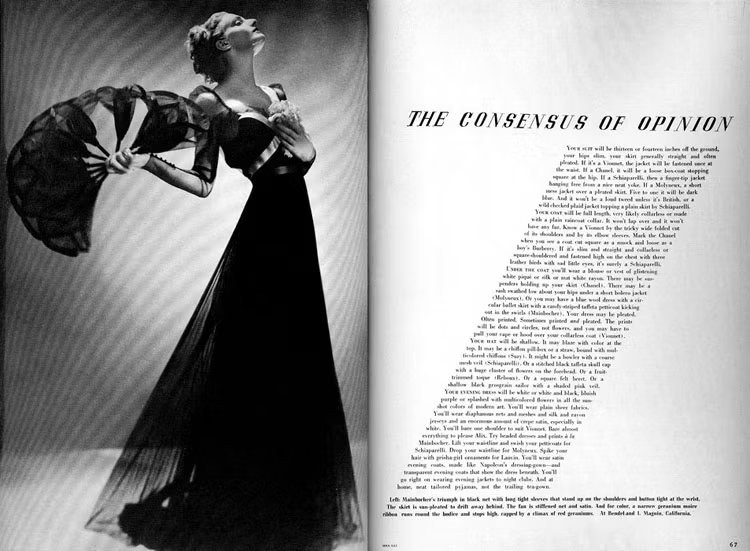
Calligraphy
Calligraphy is flawless, gorgeous handwriting. Subsequently many years of practice, calligraphers use muscle memory to perfect their style and then that the next fourth dimension they gets deputed to create a wedding invitation, for example, they tin can perfectly write all the copy on the beginning endeavour. Although hand lettering often imitates calligraphy, the procedure behind the two is very different.
Manus lettering
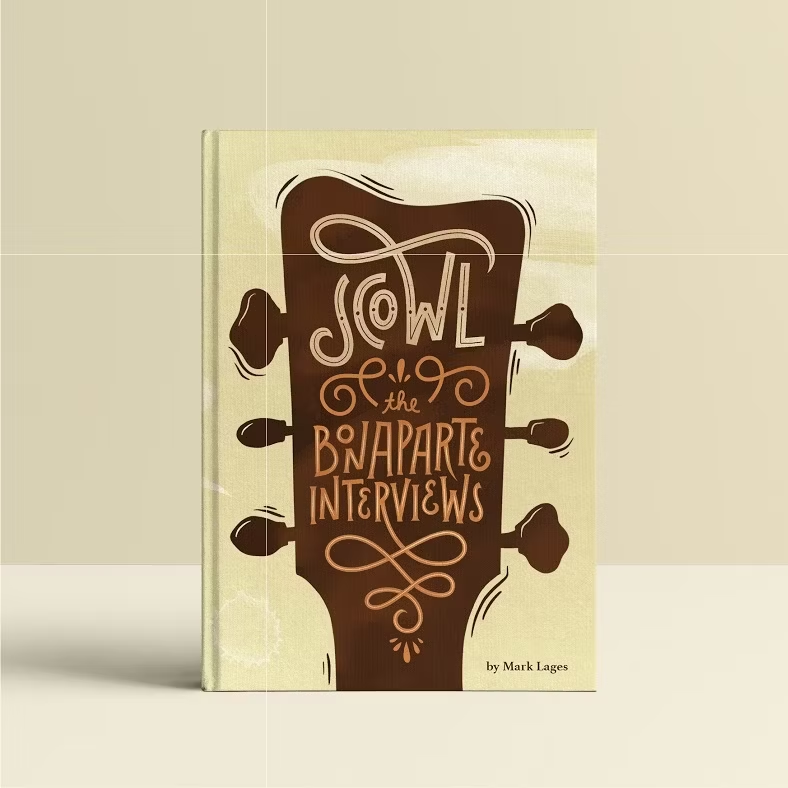
Finally, hand lettering is the art of drawing letters and can take on many shapes and sizes, from traditional-looking messages to intricate, detailed and not-and so-obvious looking ones. This can be done in whatsoever style, on whatsoever cloth, with any media.
Even though in that location are no rules in manus lettering, there are withal guidelines that we need to take into consideration.
How to start hand lettering
—
Before we first, allow's have a quick await at how hand lettering can exist used. You might be surprised to see merely how many ways there are to use this art course!
one. Get your tools
You don't need whatever fancy tools to be a hand-letterer. When I started to get into lettering, I thought I needed the nearly expensive and professional pens, judging past all those super-duper shots from Instagram. I bought a bunch of brushes and pens which I probably used… five times?
The only tools y'all will truly use are a pencil, paper, eraser and ruler. If you desire your lettering to wait calligraphic, consider using the proper calligraphic tools (such as brush pens or nibs), but yous tin practise just fine without (more than on that after).
If you lot desire to bring your lettering in the digital medium, at that place are a few ways to make it happen. To commencement digitally from scratch, use a graphic tablet or an iPad Pro and Apple Pencil to draw. Or scan your slice, and edit it in Photoshop or Illustrator by using the built-in tracing option or by tracing it yourself using the Pen tool.
two. Know about letter structure and relation
Guidelines are very of import in the process of drawing letters. They help you lot go on your letters in proper proportion so they'll have a harmonious relationship betwixt one another.
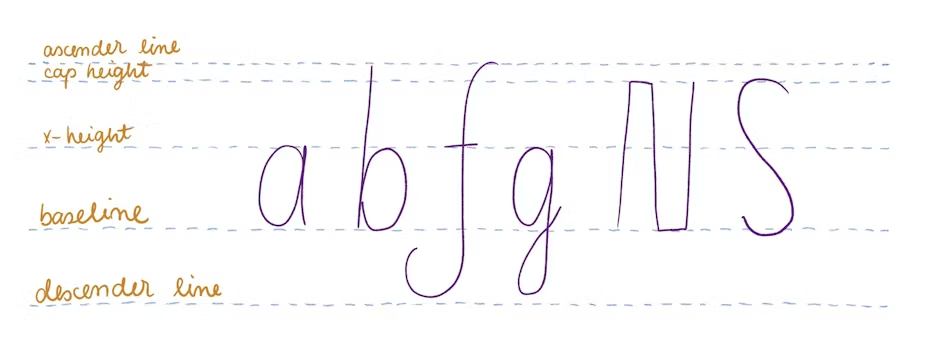
The ascender line shows how long the ascender of a lowercase letter should exist (like l, h, b). The cap height is the height of an uppercase alphabetic character. The 10-elevation is the top of a lowercase letter of the alphabet and the line that holds the crossbar. The baseline is where all messages rest. The descender line shows how long the descender of a lowercase letter should be (similar p, j, g).
In some cases, you'll accept to slightly ignore these guides and make some optical adjustments.
Here is a technique I've learned from Martina Flor. No matter what style of lettering you use, at that place are a few basic shapes that nosotros piece of work with—shapes she calls "mother forms." Nosotros have rectangular shapes (like the letters H or E), triangular shapes (similar the letters Five or A), rounded shapes (similar the letters O or C) plus the combination of all of these.
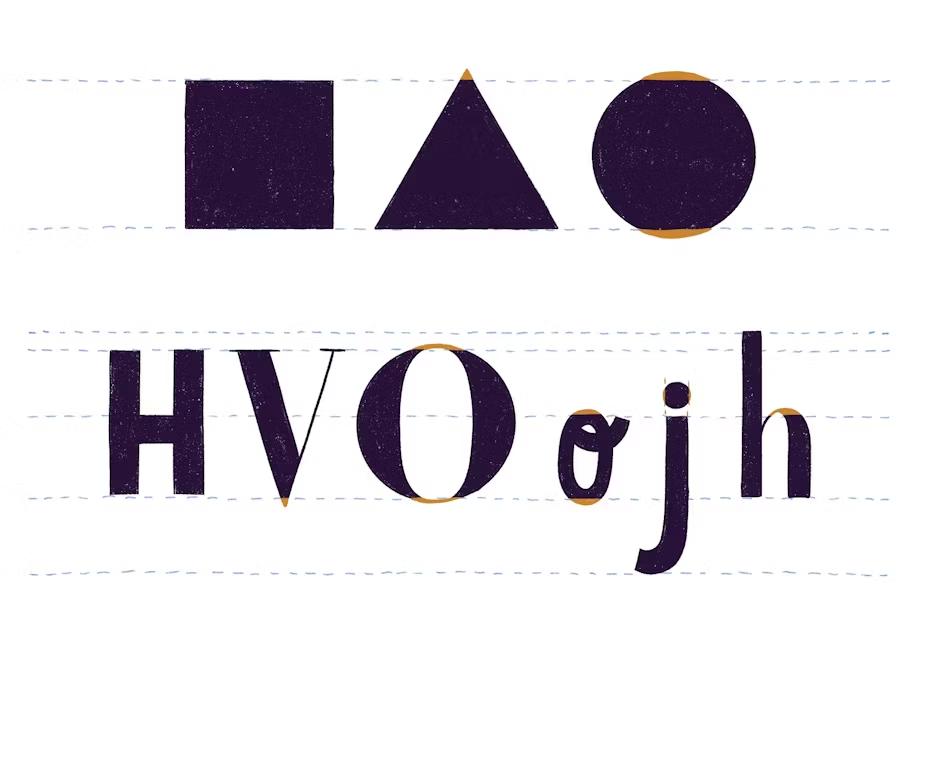
If you take all these shapes on the same baseline, all the exact aforementioned size, the circle and the triangle would wait significantly smaller than the rectangle. Why? Because the square touches the baseline and cap pinnacle with its entire border, while the circle and triangle don't.
Even if technically they are the aforementioned size, optically they're not. This is when you'll apply your eyes and instincts to enlarge those messages simply a little over the baseline and cap height. How much should you enlarge them? Well, that'southward up to you! In time, y'all'll observe it easier until you'll do it without even thinking virtually it. The aforementioned dominion goes for the lowercase messages, too.
three. Learn the anatomy of letters
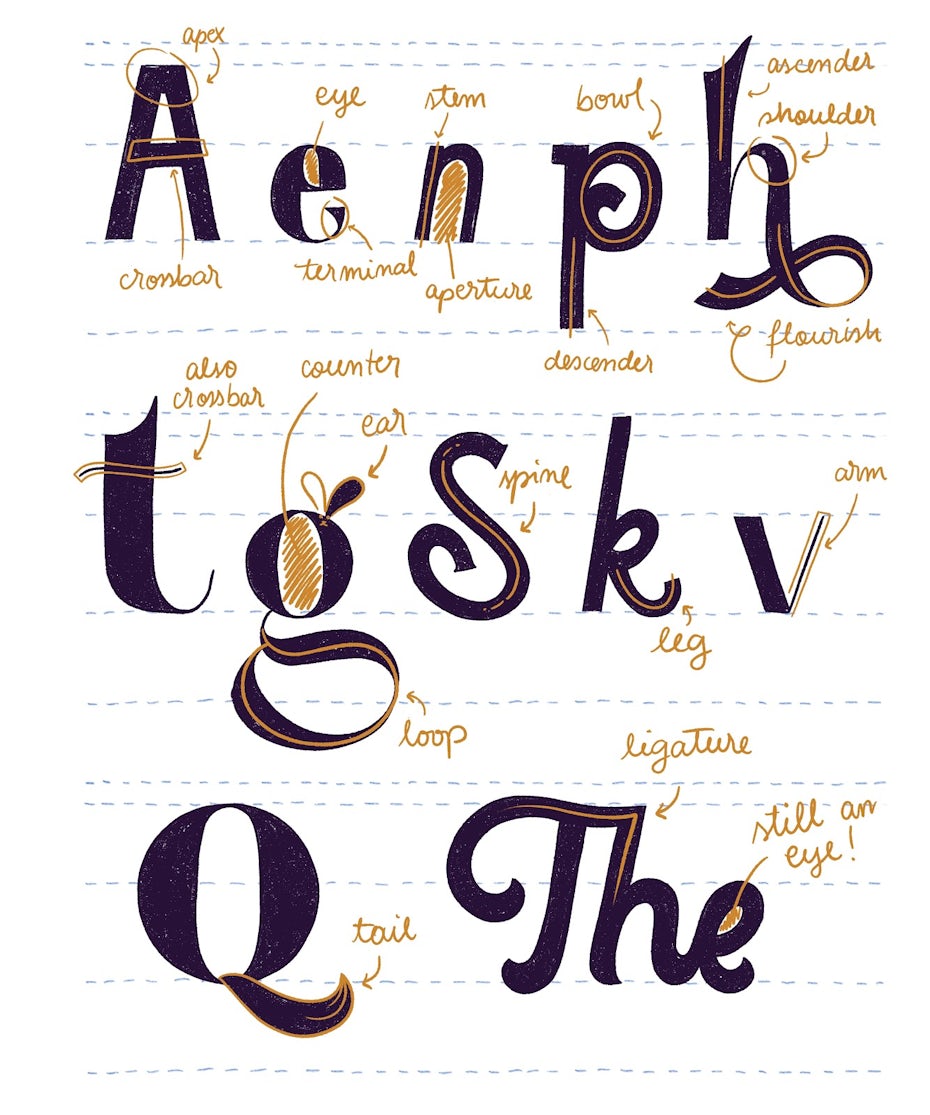
Earlier you swoop into the actual lettering, it's of import to know the most unremarkably used terms, and so that adjacent time you'll be able to call the 'little matter on the end of a lowercase letter' past its proper name—a terminal. In one case you lot know these terms, yous'll exist able to talk with anyone about this topic.
Here are the ones you lot'll utilize the most:
four. Choose a lettering style
This is where we become wild! As a letterer, you lot take to know all the different styles then y'all can cull the i that fits your current project the best. Knowing the basic styles volition aid you create endless variations of the same alphabetic character.
We still take some rules to play by, just your imagination can go crazy!
The most important rule to continue in mind at all times is legibility. You can create the most ornate, fancy looking E, but at the finish of the day, if information technology can't exist easily recognized as an E y'all failed. Since there'due south non just one right fashion to draw an Eastward (except for its basic skeleton, which tin can nevertheless be modified), it's up to the states to decide how to describe it.
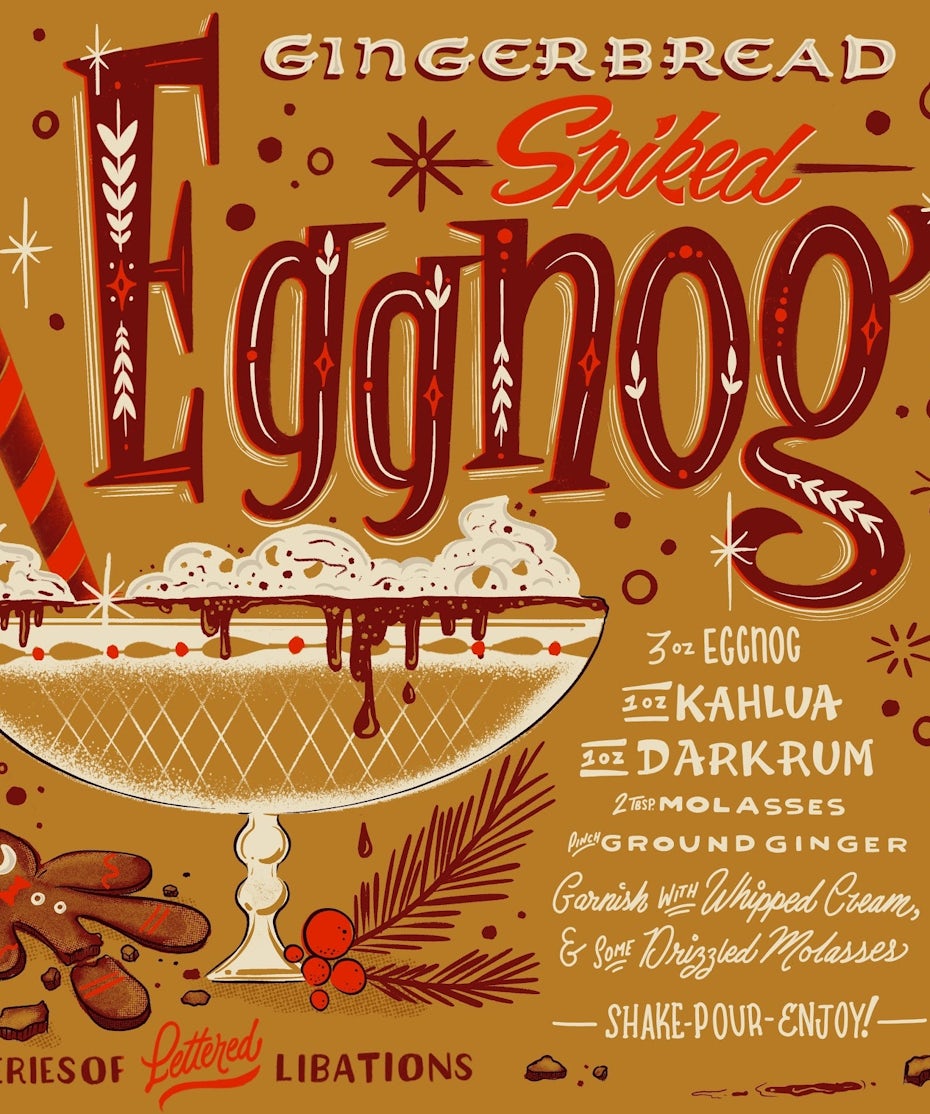
Set up? Here we go!
Serif lettering
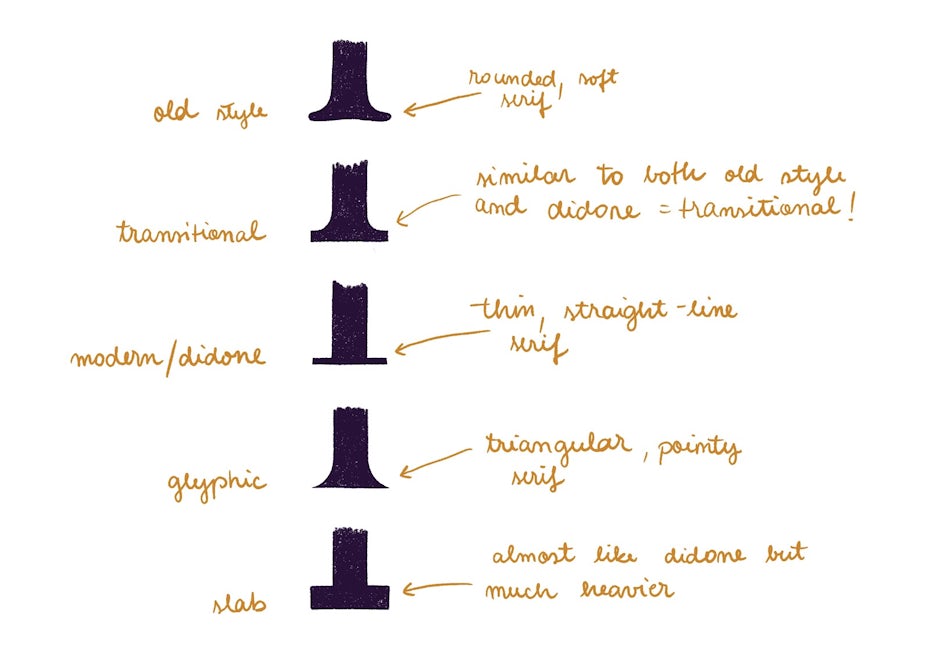
A serif is the small-scale line fastened at the end of a alphabetic character's stroke. Initially, information technology was invented to help with legibility only designers and letterers have pushed information technology and reinvented it many, many times, creating some really funky and interesting serifs.
Within this category, there are many other styles. We've got erstwhile style serifs, transitional serifs, didone or modern serifs, glyphic serifs or slab serifs. Whoa, right?
Let's take a look at what all these look similar:
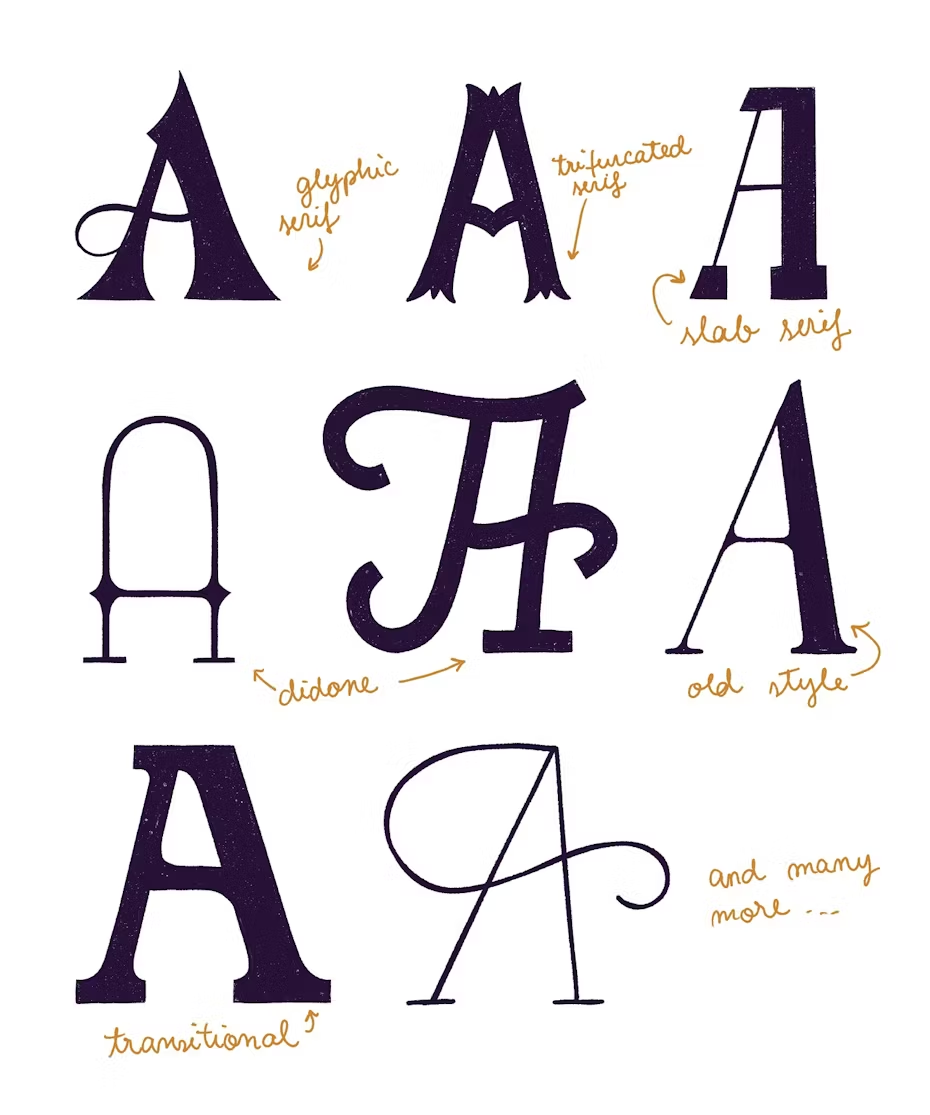
And here are a few examples of all the ways you lot tin can utilise them:
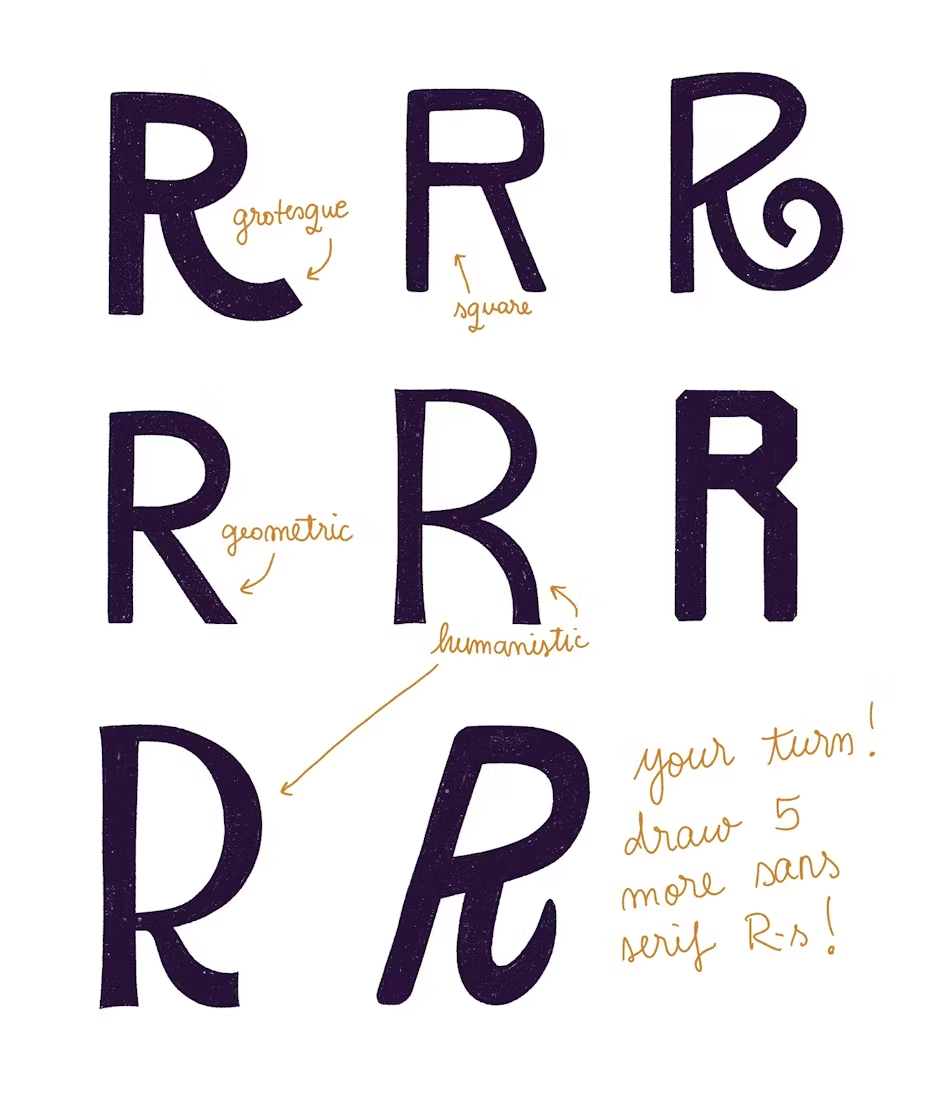
Sans serif lettering
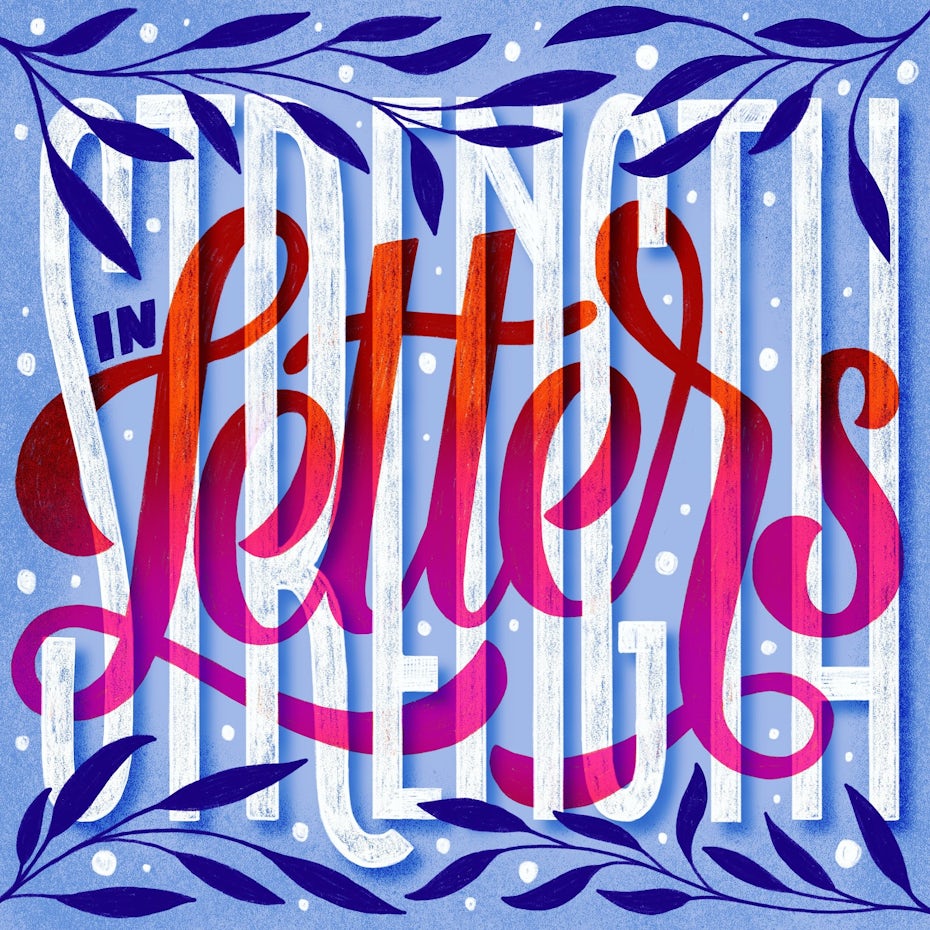
"Sans" ways without. So this category of lettering contains typography that has no lines attached to the ends of each letterform. Sans serif lettering is frequently used to convey a more contemporary manner.
Fifty-fifty though these letterforms take a more basic construction than serifs, at that place are still a number of artistic ways to do this. You might recollect at that place'south non much you tin can practice with something then simple, but let me prove yous incorrect!
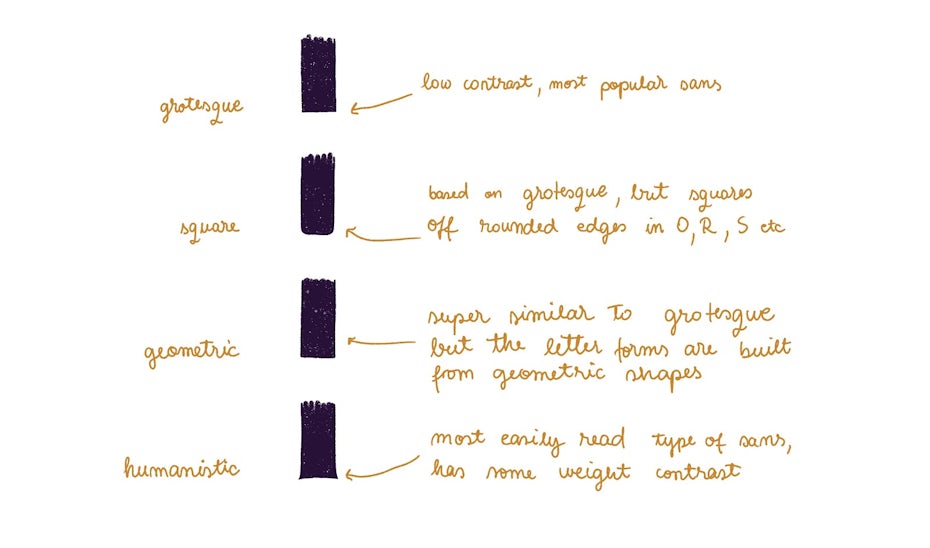
Allow'south meet a few of these in activeness:
Script and castor lettering
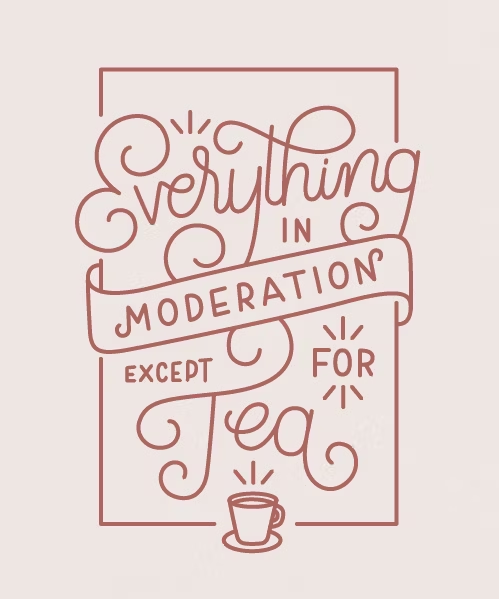
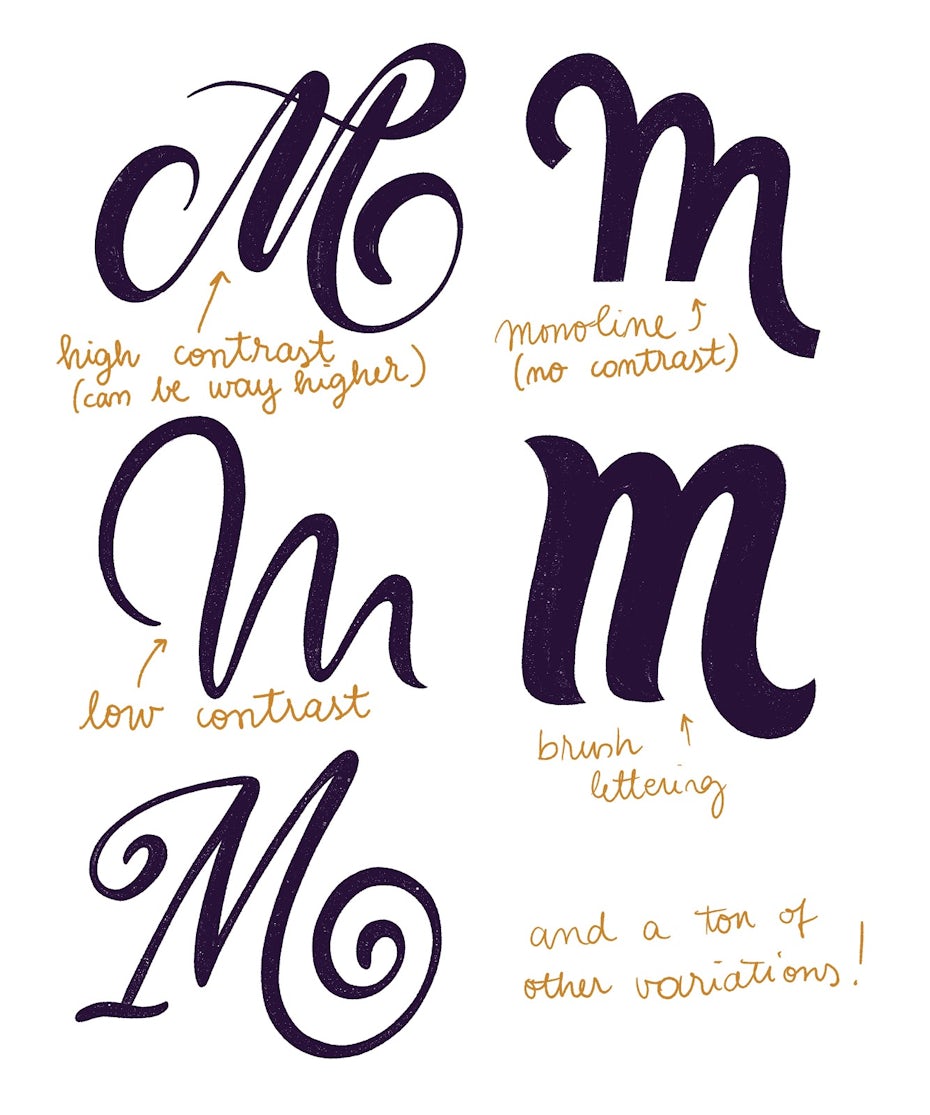
Script and castor lettering refers to letterforms that are connected to each other. This tin can exist very formal looking and elegant, playful or fifty-fifty super trashy. This style imitates calligraphy, but instead of drawing the letters with a single movement of the paw similar you would in calligraphy, you draw the messages from many little pencil strokes to build that expect.
The most important rule to keep in listen is that a letter's upstroke is always sparse, and its downstroke is ever thick. Upward thin, downward thick. You minimize the force per unit area of the pen on the ups, you lot push and create more pressure on the downs. Up sparse, downward thick. Up sparse, downward thick. That's simply four words to memorize!
You can also play around with a brush pen or different nibs to get the experience of the stroke then that yous'll know what you lot have to imitate.
These are the iii basic lettering styles. Tweak them however yous please, and get to some really crazy, funky looking letters.
Make the letters very slim or very fat. Invert the weights to get that bang-up feel. Add a super heavy weight contrast. Use really crazy serifs or flourishes.
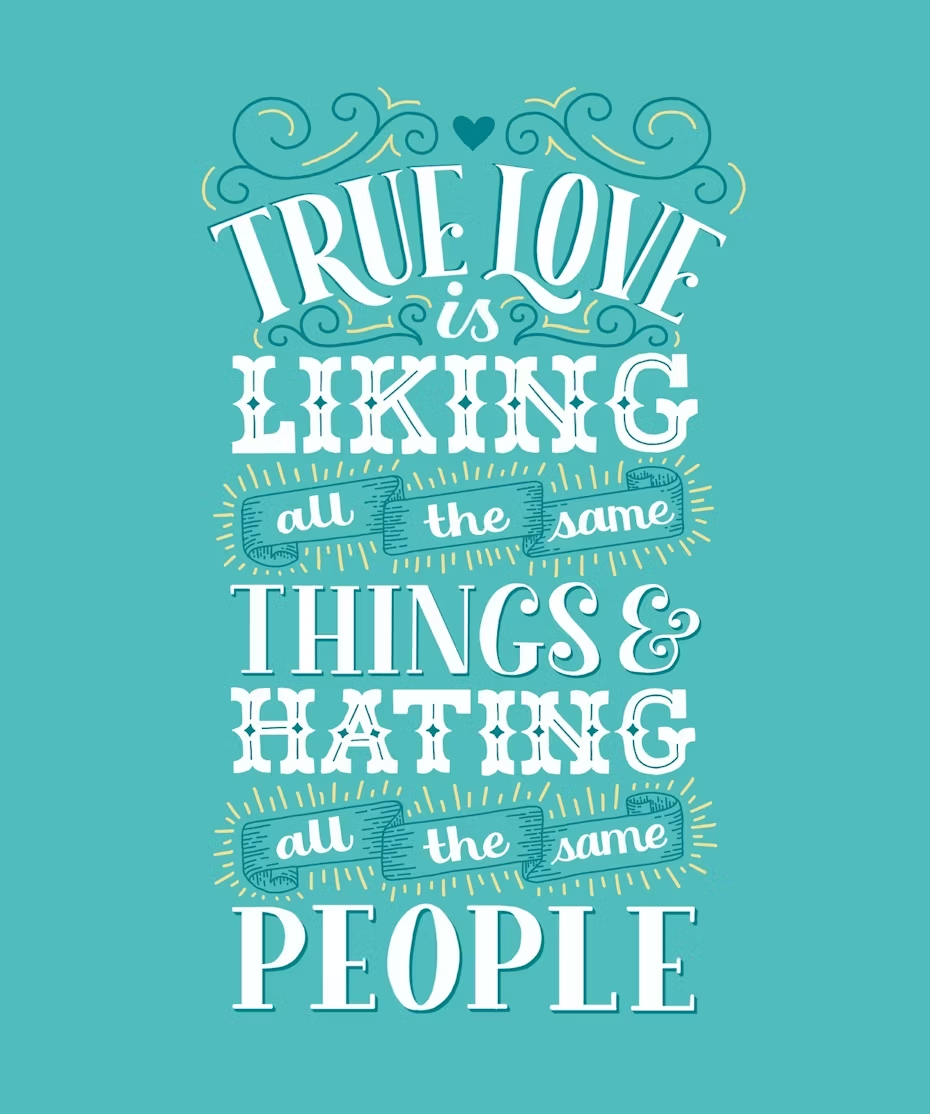
There's really no limit to what you lot tin can attain. Simply take fun with information technology!
5. Add dimension, details and decorative elements
Now that you are more familiar and comfortable with the basic way categories, let's take a look at what we can do to make them more interesting and decorative.
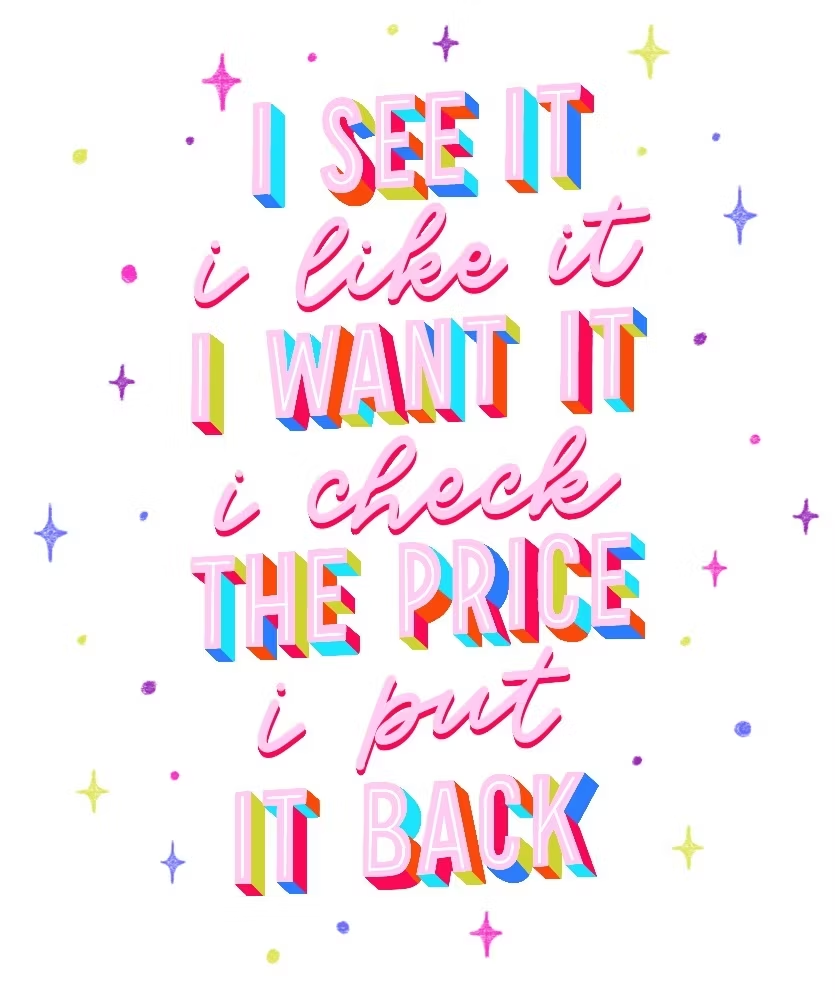
Adding dimension and shadow
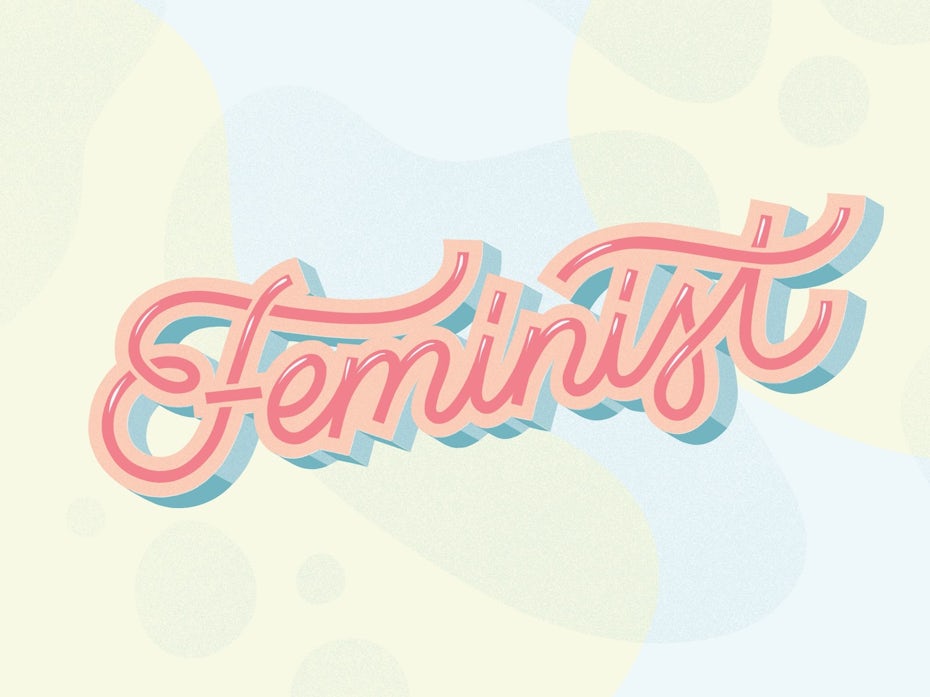
When we talk most dimension, nosotros're talking about 3 types of shading: the driblet line, drib shade and drop shadow. You lot can create these by drawing the same shape behind your primary 1. Simple as that. If yous got comfortable with creating these yous can play around with them and make some really interesting shadows to brand your letterforms fifty-fifty more than expressive.
For example, you can create a vanishing bespeak and connect all the edges of the letter (or word) to the same point, or you lot can have some actually heavy, bold shadows, playing with the positioning.
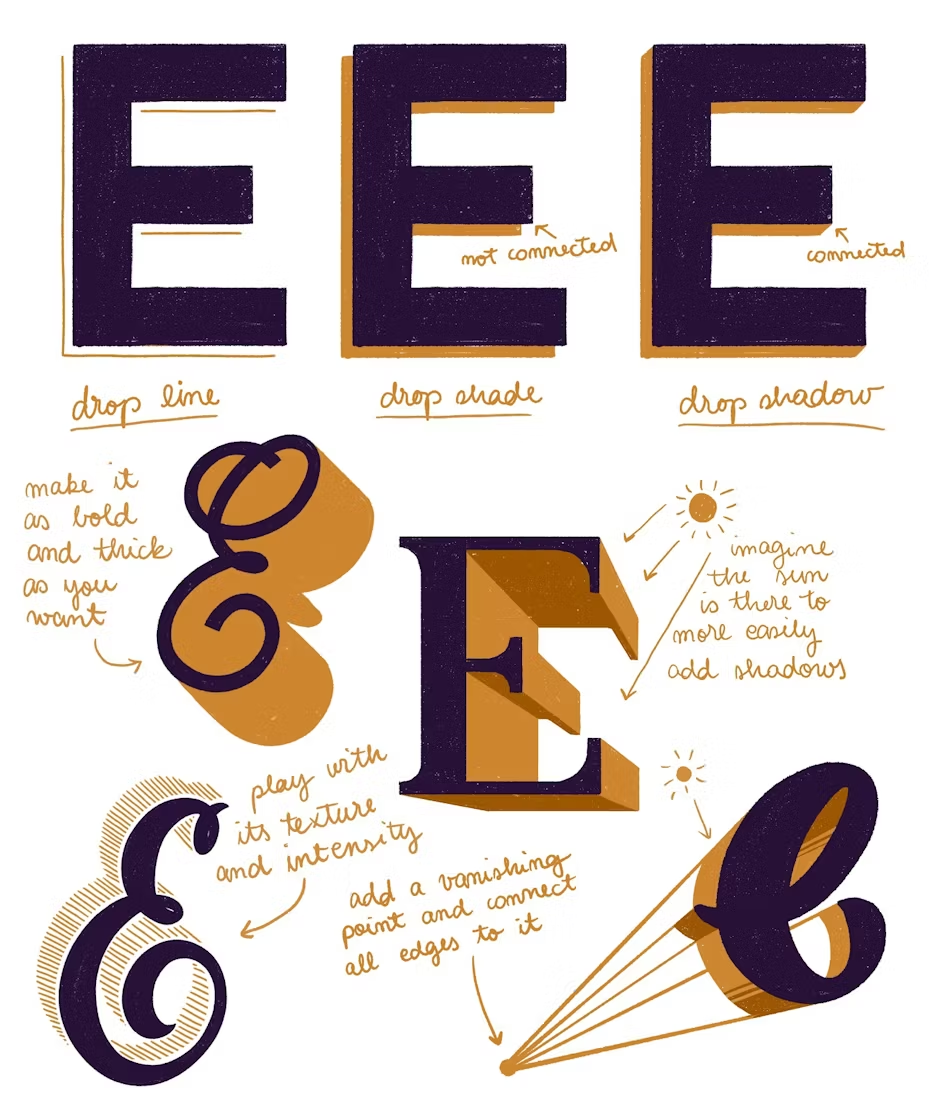
If yous have all your dimension added you tin go alee and add together even more depth. Make up one's mind where your low-cal source is coming from and draw the dark parts in wherever the light wouldn't touch your letter.
An easy style to figure this out is if you imagine your letter is an actual object on a tabular array. Look at unlike objects in your room, both rounded and rectangular, to get a feel of how the lights and shadows play on it. Information technology takes a little practice to become it right, but hey, practise makes perfect!
Add together details
Sometimes you will need to add some details on the messages themselves. Add anything from a unproblematic inline to intricate flourishes and shading. Allow's have a look at merely a few examples:
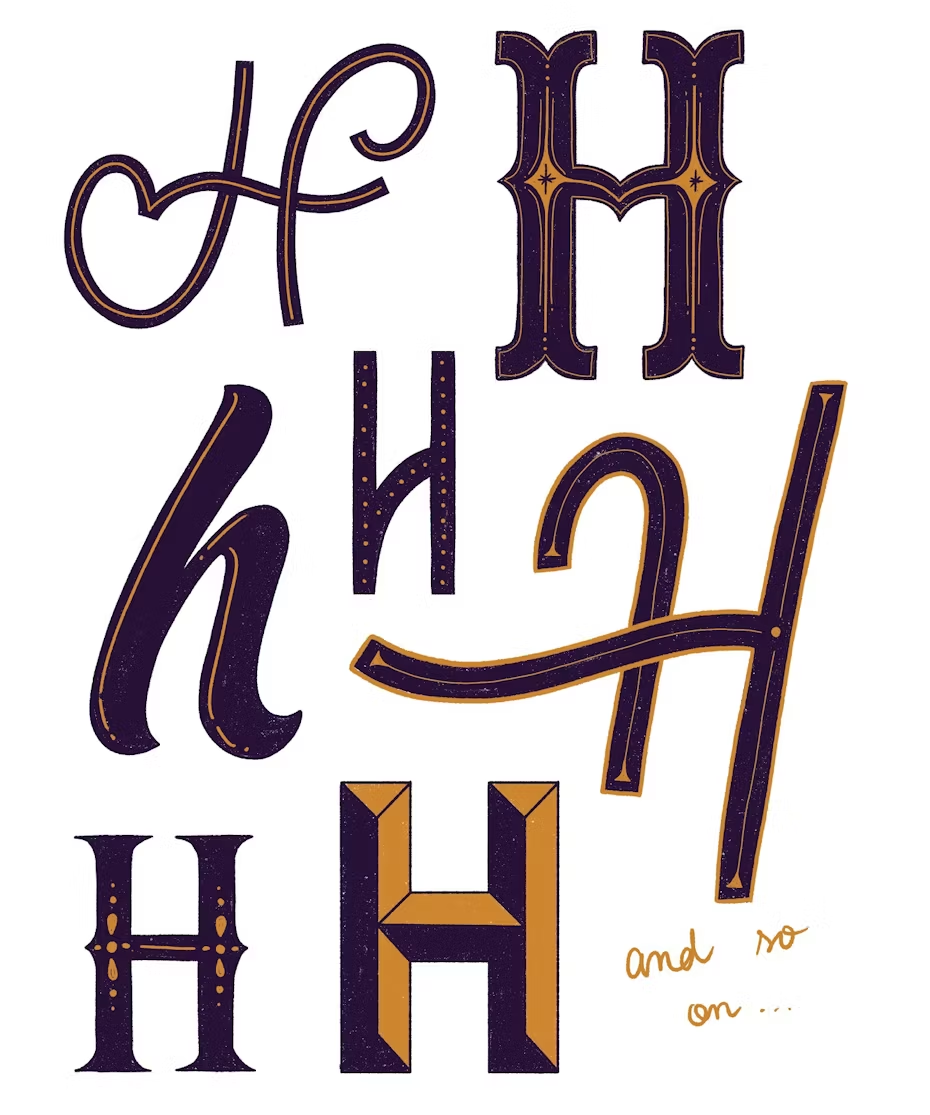
There is no rule for how to add these, except for keeping the letterforms legible and relevant to your project.
Adding decorative elements
At times, you'll want to fill the empty infinite around your messages. Once again, keep the letters readable at all times.
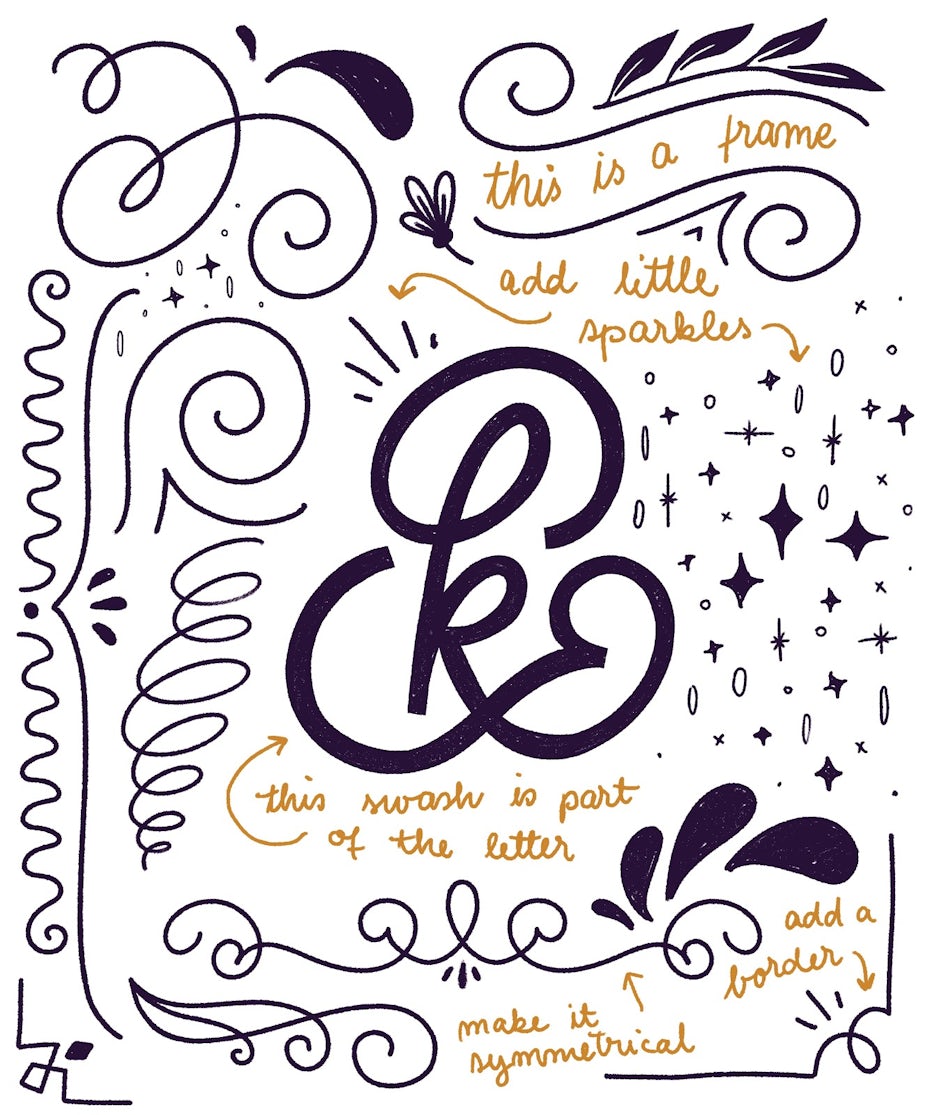
Make sure you don't go too crazy with the flourishes and little decorative elements. Or if you choose to go crazy, do information technology in a way that fits your concept and style.
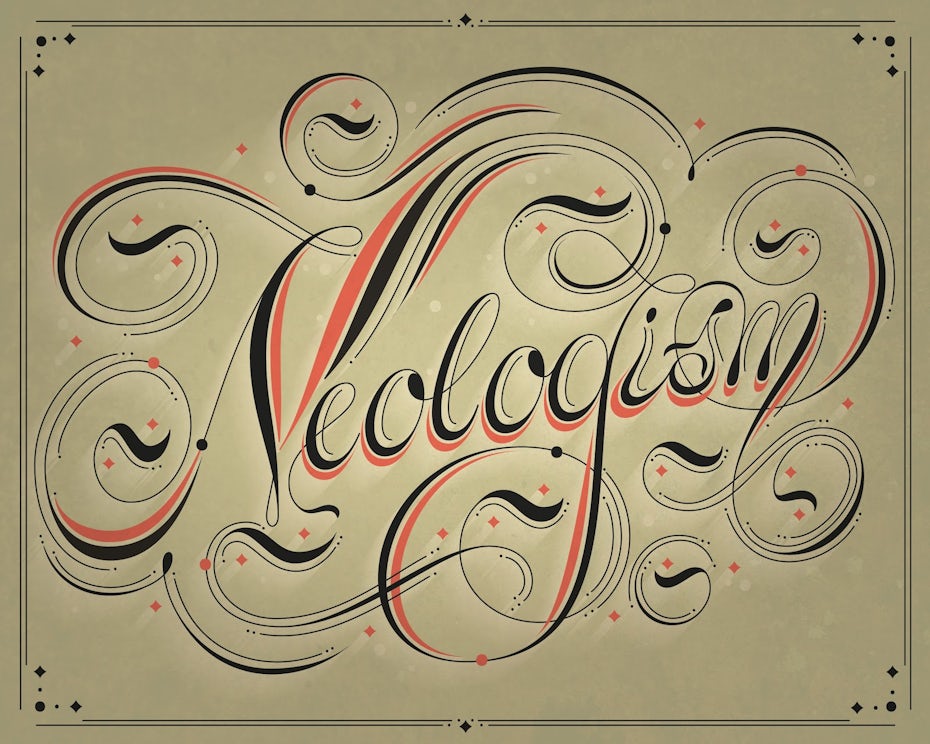
These flourishes and swashes can exist role of your letters or stand up on their own. Either way, they tin can help balance out your composition and brand your letters stand out.
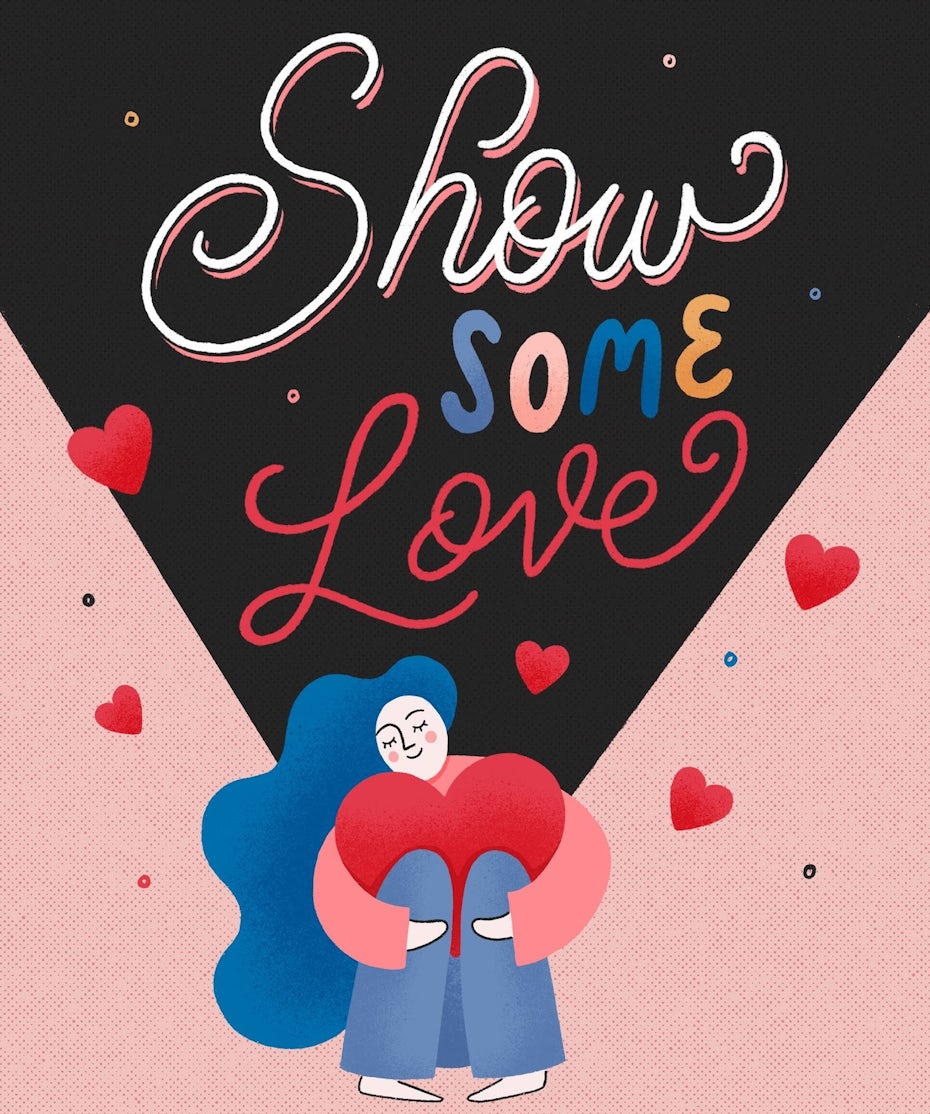
5. Draw expressive letterforms
Let's do some actual lettering!
As a hand letterer you demand to be able to express feelings and emotions solely with the mode of the fatigued letters. For instance, you lot most probably won't be using a decorative, circusy slab serif for the championship of a fancy issue invitation (except if information technology's a circus conference?) or a sophisticated script lettering for a sports magazine comprehend.
Practice by trying to illustrate random words with the assist of messages. Selection your word and think about what feelings can that word evoke. Write a listing with everything that comes to your mind when you think most the given word. You can write objects, feelings, styles, anything. The longer the list, the better.
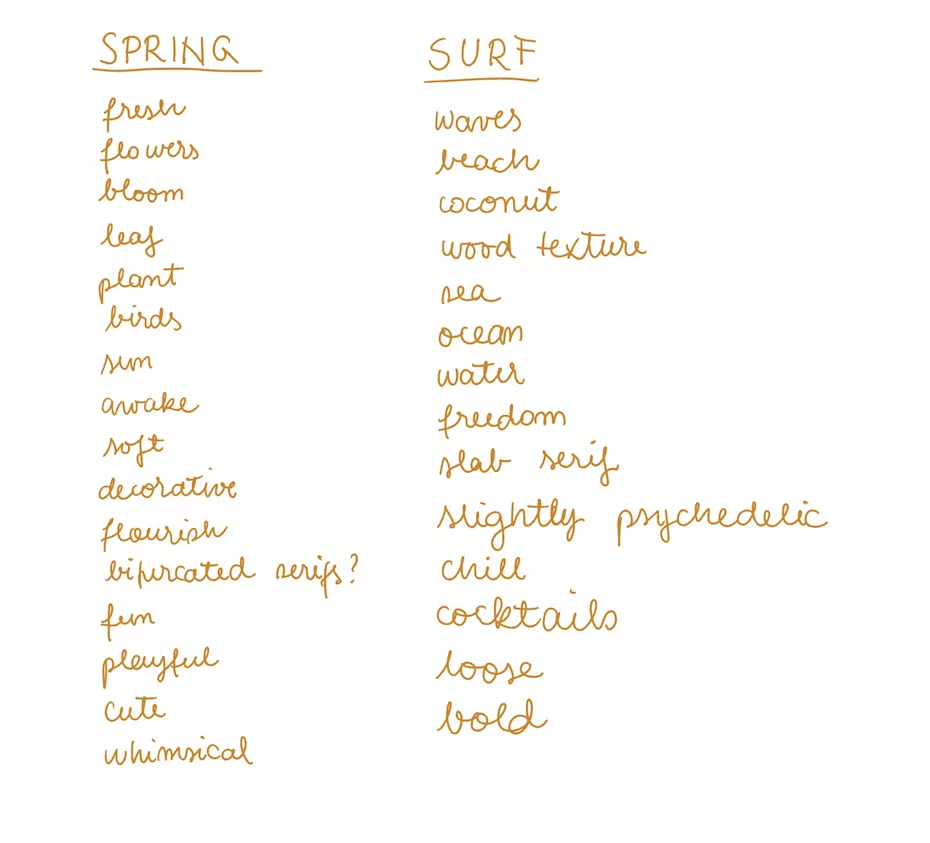
You lot don't have to use each of these ideas, but it'southward useful to run across them all and use the ones that fit your concept the best.
Later on you feel similar you got everything you need, start drawing. At get-go, focus solely on getting the idea from your caput to the paper. Don't go precious with your sketches. Don't focus on details, and don't get sorry if you mess it upward. A sketch is supposed to be messy! Try to sketch fast, without overthinking information technology and listen to your instincts. Sketch out more than just one concept for the chosen give-and-take and then that you'll exist able to choose the best.
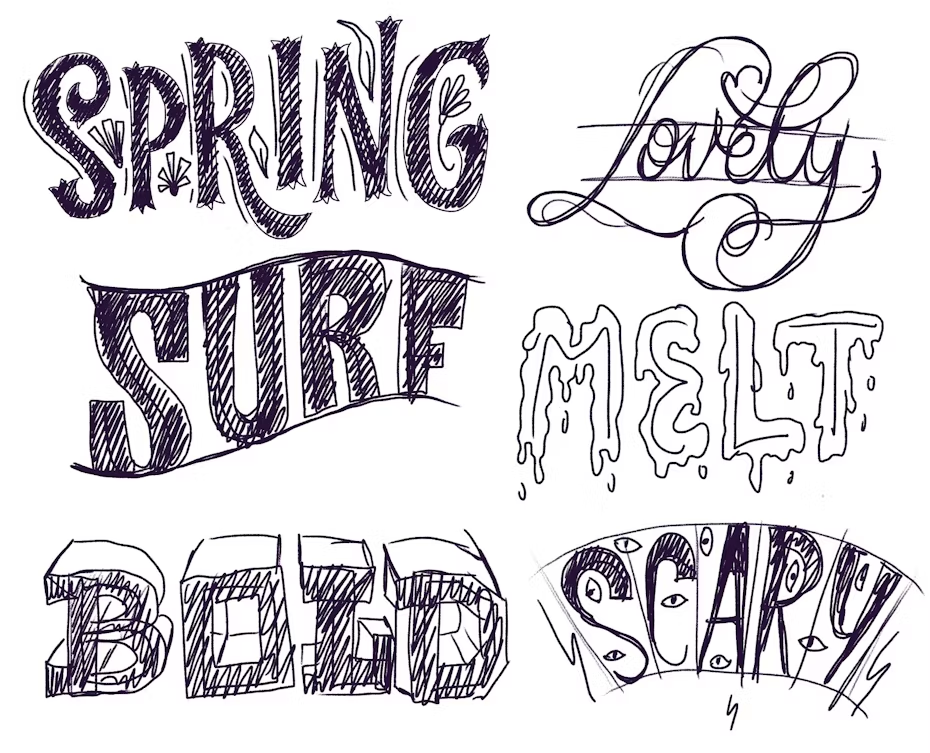
A trivial flim-flam virtually sketching is to always start with the skeleton of the messages and add weights after. You'll have a solid foundation to build on so you'll be able to concentrate on the very construction of the messages.
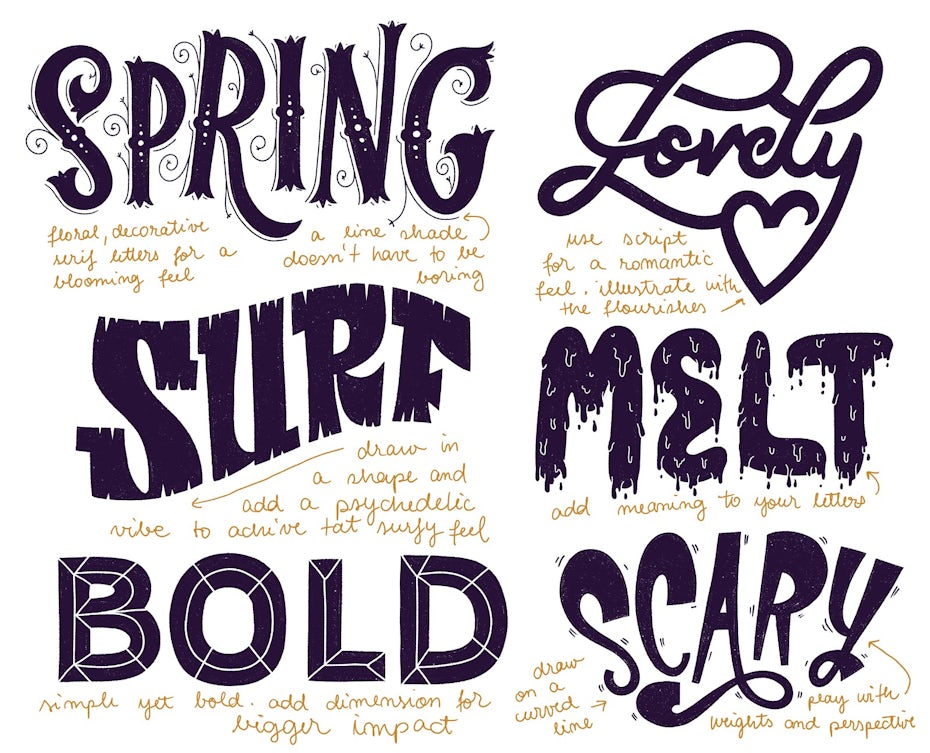
Also, try to not just draw the discussion in a sure manner, but use objects to represent it. For example, you might build the word 'bones' from little letter shaped bones or depict actual melting letters for the give-and-take 'melt'.
After you've narrowed information technology down to one concept per word, continue sketching and refining. This is where yous add dimension, flourishes and decorative elements. Reference your listing to use relevant elements!
Now, instead of using one style to define the discussion, use many dissimilar styles to give the same give-and-take different meanings.
Follow the same blueprint: cull your word, write the listing and go sketching! Again, don't get precious with your initial sketches, merely let your ideas period. Call back about the many emotions 1 give-and-take tin evoke. You lot'd be surprised to see how the vibe of one word tin change just by cartoon it differently.
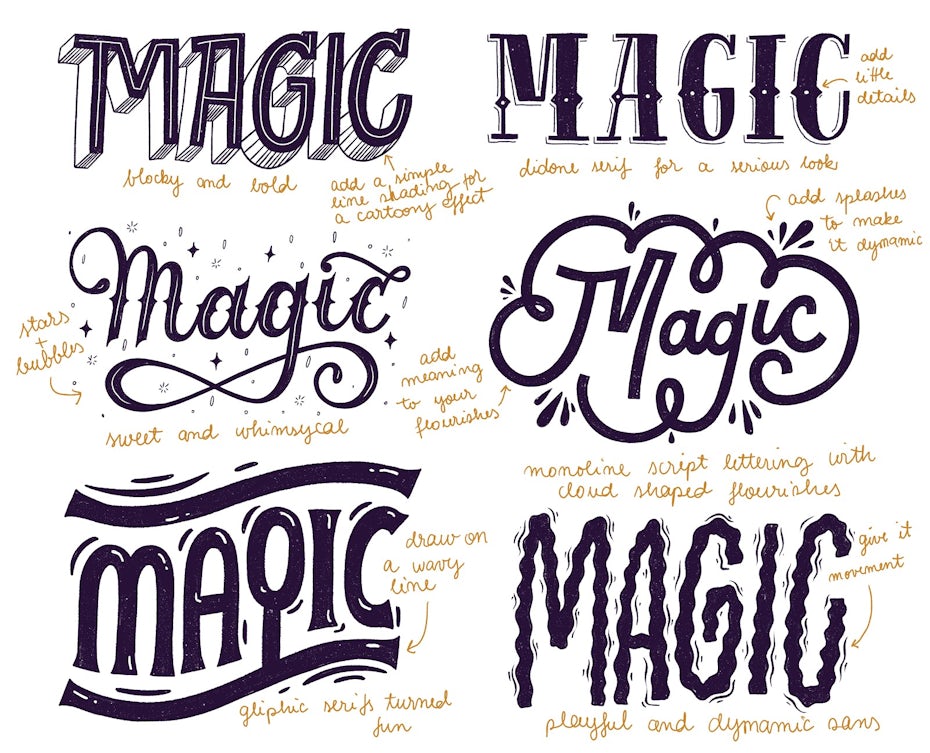
Pretty fun, isn't information technology? You tin echo this exercise daily and you'll first to run into improvement sooner that you might look. Don't forget to keep your letters legible, just allow yourself to make mistakes!
Bring mitt lettering to your own designs!
—
If you fabricated information technology through this tutorial, you lot're awesome and one stride closer to mastering the fine art of paw lettering. Exist proud! I know that getting started can be intimidating, only yous'll soon observe that mitt lettering can be such a fun form of art.
You probably take the urge to jump into hand lettering caput first, and start drawing intricate, detailed quotations. But beginning, get comfortable with cartoon a single word. You can't build a house if you lot don't have strong bricks, right? With these basics, you have endless possibilities to describe letters and better your skills.
In one case you start creating, share your work with the globe! Think, anybody started out as a beginner, and anybody needs their fellow artists to requite them a little nudge every at present and then.
>> Ready for the avant-garde class? Read our tutorial to manus lettering quotes and sentences.

Source: https://99designs.com/blog/design-tutorials/basics-of-hand-lettering-tutorial/
Posted by: robbfarome.blogspot.com
0 Response to "How To Draw Fancy Cursive Letters How To Draw Fancy Letters"
Post a Comment