In [1]:                        import            pandas            as            pd          
  • Air quality data

    For this tutorial, air quality data about \(NO_2\) is used, made available by openaq and using the py-openaq package. The air_quality_no2.csv data set provides \(NO_2\) values for the measurement stations FR04014, BETR801 and London Westminster in respectively Paris, Antwerp and London.

    To raw data

                                        In [2]:                                    air_quality                  =                  pd                  .                  read_csv                  (                  "data/air_quality_no2.csv"                  ,                  index_col                  =                  0                  ,                  parse_dates                  =                  True                  )                  In [3]:                                    air_quality                  .                  head                  ()                  Out[3]:                                                                          station_antwerp  station_paris  station_london                  datetime                                    2019-05-07 02:00:00              NaN            NaN            23.0                  2019-05-07 03:00:00             50.5           25.0            19.0                  2019-05-07 04:00:00             45.0           27.7            19.0                  2019-05-07 05:00:00              NaN           50.4            16.0                  2019-05-07 06:00:00              NaN           61.9             NaN                

How to create new columns derived from existing columns?
../../_images/05_newcolumn_1.svg
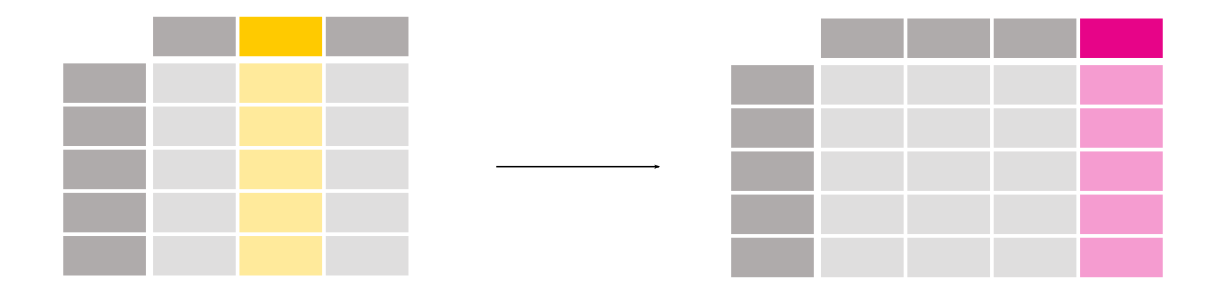
  • I want to express the \(NO_2\) concentration of the station in London in mg/m\(^3\)

    (If we assume temperature of 25 degrees Celsius and pressure of 1013 hPa, the conversion factor is 1.882)

                                        In [4]:                                    air_quality                  [                  "london_mg_per_cubic"                  ]                  =                  air_quality                  [                  "station_london"                  ]                  *                  1.882                  In [5]:                                    air_quality                  .                  head                  ()                  Out[5]:                                                                          station_antwerp  station_paris  station_london  london_mg_per_cubic                  datetime                                    2019-05-07 02:00:00              NaN            NaN            23.0               43.286                  2019-05-07 03:00:00             50.5           25.0            19.0               35.758                  2019-05-07 04:00:00             45.0           27.7            19.0               35.758                  2019-05-07 05:00:00              NaN           50.4            16.0               30.112                  2019-05-07 06:00:00              NaN           61.9             NaN                  NaN                

    To create a new column, use the [] brackets with the new column name at the left side of the assignment.

Note

The calculation of the values is done element_wise. This means all values in the given column are multiplied by the value 1.882 at once. You do not need to use a loop to iterate each of the rows!
../../_images/05_newcolumn_2.svg
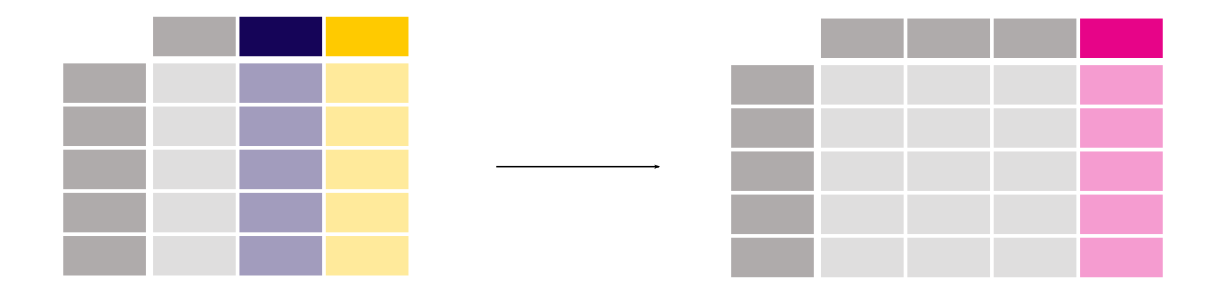
  • I want to check the ratio of the values in Paris versus Antwerp and save the result in a new column

                                        In [6]:                                    air_quality                  [                  "ratio_paris_antwerp"                  ]                  =                  (                                      ...:                                    air_quality                  [                  "station_paris"                  ]                  /                  air_quality                  [                  "station_antwerp"                  ]                                      ...:                                    )                                      ...:                                    In [7]:                                    air_quality                  .                  head                  ()                  Out[7]:                                                                          station_antwerp  station_paris  station_london  london_mg_per_cubic  ratio_paris_antwerp                  datetime                                    2019-05-07 02:00:00              NaN            NaN            23.0               43.286                  NaN                  2019-05-07 03:00:00             50.5           25.0            19.0               35.758             0.495050                  2019-05-07 04:00:00             45.0           27.7            19.0               35.758             0.615556                  2019-05-07 05:00:00              NaN           50.4            16.0               30.112                  NaN                  2019-05-07 06:00:00              NaN           61.9             NaN                  NaN                  NaN                

    The calculation is again element-wise, so the / is applied for the values in each row.

Also other mathematical operators ( + , - , \* , / ) or logical operators ( < , > , = ,…) work element wise. The latter was already used in the subset data tutorial to filter rows of a table using a conditional expression.

If you need more advanced logic, you can use arbitrary Python code via apply() .

  • I want to rename the data columns to the corresponding station identifiers used by openAQ

                                        In [8]:                                    air_quality_renamed                  =                  air_quality                  .                  rename                  (                                      ...:                                    columns                  =                  {                                      ...:                                    "station_antwerp"                  :                  "BETR801"                  ,                                      ...:                                    "station_paris"                  :                  "FR04014"                  ,                                      ...:                                    "station_london"                  :                  "London Westminster"                  ,                                      ...:                                    }                                      ...:                                    )                                      ...:                                  
                                        In [9]:                                    air_quality_renamed                  .                  head                  ()                  Out[9]:                                                                          BETR801  FR04014  London Westminster  london_mg_per_cubic  ratio_paris_antwerp                  datetime                                    2019-05-07 02:00:00      NaN      NaN                23.0               43.286                  NaN                  2019-05-07 03:00:00     50.5     25.0                19.0               35.758             0.495050                  2019-05-07 04:00:00     45.0     27.7                19.0               35.758             0.615556                  2019-05-07 05:00:00      NaN     50.4                16.0               30.112                  NaN                  2019-05-07 06:00:00      NaN     61.9                 NaN                  NaN                  NaN                

    The rename() function can be used for both row labels and column labels. Provide a dictionary with the keys the current names and the values the new names to update the corresponding names.

The mapping should not be restricted to fixed names only, but can be a mapping function as well. For example, converting the column names to lowercase letters can be done using a function as well:

                            In [10]:                            air_quality_renamed              =              air_quality_renamed              .              rename              (              columns              =              str              .              lower              )              In [11]:                            air_quality_renamed              .              head              ()              Out[11]:                                                          betr801  fr04014  london westminster  london_mg_per_cubic  ratio_paris_antwerp              datetime                            2019-05-07 02:00:00      NaN      NaN                23.0               43.286                  NaN              2019-05-07 03:00:00     50.5     25.0                19.0               35.758             0.495050              2019-05-07 04:00:00     45.0     27.7                19.0               35.758             0.615556              2019-05-07 05:00:00      NaN     50.4                16.0               30.112                  NaN              2019-05-07 06:00:00      NaN     61.9                 NaN                  NaN                  NaN            

To user guide

Details about column or row label renaming is provided in the user guide section on renaming labels.

REMEMBER

  • Create a new column by assigning the output to the DataFrame with a new column name in between the [] .

  • Operations are element-wise, no need to loop over rows.

  • Use rename with a dictionary or function to rename row labels or column names.